




About The Event
Organic Cations and Crystal Defects in Hybrid Perovskites
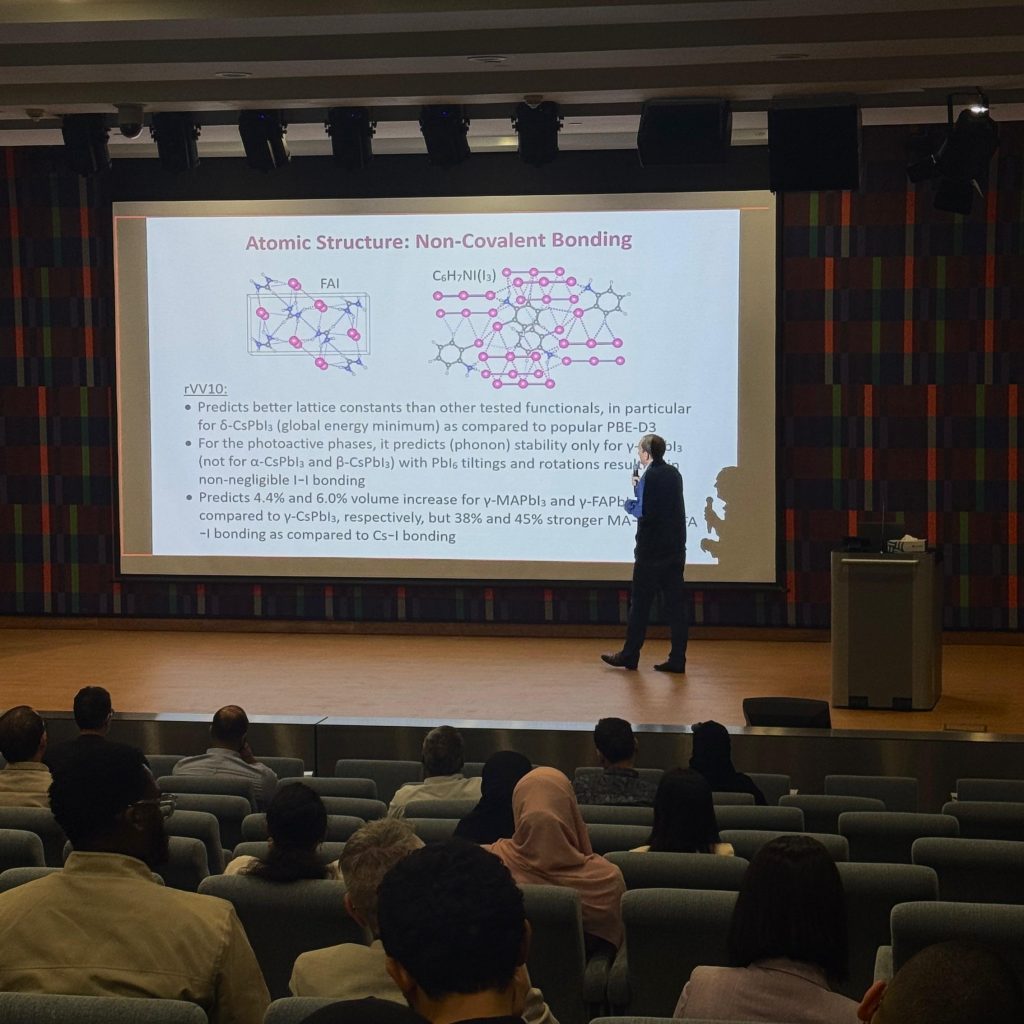
The photoconversion efficiency record of silicon-perovskite solar cells exceeds 30% owing to hybrid perovskites ΆPbX3 with organic cations Ά that stabilize the perovskite sublattice not only by ionic bonding but also by non-covalent bonding (that is absent in all-inorganic perovskites). As the lowest-energy electronic transitions mainly involve orbitals of the inorganic skeleton, the optoelectronic properties are determined by the halogen composition X, PbX6 tiltings and rotations, and bulk and surface defects. The main drawbacks of hybrid perovskites are their intrinsic instability towards photoinactive δ-phases and degradation by light, heat, oxygen, and moisture, for example. We address the stability issue from the perspectives of the bulk crystal phases, point defects, and surfaces and interfaces. It is shown that the softness of the lattice allows various organic cations to fit into and bond stronger with the inorganic skeleton than methylammonium and formamidinium, enabling mixed-cation compositions of higher stability. It is also shown that the inorganic Ba, Hg, and Tl cations provide stabilization, with Ba and Tl additionally suppressing halogen migration. I-defects creating I⸱⸱⸱I2⸱⸱⸱I motives are beneficial by inducing localized states below the conduction band edge, while defects creating Pb-Pb or I-O bonds as well as O2 interstitials turn out to be detrimental for the optoelectronic properties. Heteroaromatic functionalization of the methylammonium and formamidinium cations as well as I2 treatment creating surface I⸱⸱⸱I2⸱⸱⸱I motives stabilize surfaces and interfaces, enhancing the charge transfer to C60-based charge transport layers.