






Research Lab
The facilities available at RIC2D extend beyond the impressive physical suite of assets and sophisticated state-of-the-art equipment to reach into a full-on thorough and comprehensive service related to all advanced material innovation needs from idea screening all the way through to proof-of-concept development and all the characterization that comes along with it.
RIC2D itself expands over 600 m2 of floor space which comprises mainly of, Project labs, Clean-room & Offices and storage rooms.
The Research labs, where the researchers and users get the freedom and facilities to deploy their talents and engage in their work, comprise of (i) Advanced Materials Characterization and Preparation labs having Advanced Characterization equipment and fume hoods (ii) Project Labs and (iii) Clean-room.
Advanced Materials Characterization & Sample Preparation Labs
| The Advanced Materials Characterization and Preparation Labs comprise of; (A) dry areas housing some of the more sophisticated surface and structural equipment; including: | |
|---|---|
|
Atomic Force Microscope (AFM) – FX40 – Park Systems |
State-of-the-art AFM with integrated intelligence and robotics providing unparalleled autonomy and advanced technology for accelerating surface characterisation of materials at the forefront of groundbreaking research. |
|
Nanoindenter / Mechanical Tester – PB1000 – Nanovea |
It enables researchers to measure mechanical properties such as modulus and hardness of materials in different shapes, sizes and scales. This instrument has the ability to determine the nano- and microscale properties of materials with complex microstructures as well as those of limited sample dimension. Offers utility in the characterization of structural tissues, hydrogels, polymers and composites. |
|
Confocal Raman Microscope – InVia Qontor – Renishaw |
Signature instrument for 2D materials characteriztion and fingerprinting. The inVia confocal Raman microscope delivers outstanding performance and best data in the shortest time. It provides highly specific identification, high spatial resolution, a range of microscope contrast techniques, advanced particle analysis and smart correlative imaging, enabling even the most challenging experiments. |
|
FTIR with Microscope and PL Module – Vertex80v Hyperion II – Bruker |
Vacuum FTIR spectrometer providing peak spectral resolution over the full spectral range. Its quality optics and innovative design enables demanding experiments such as high resolution, ultra fast rapidscan, step-scan or UV spectral range measurements. The Vertex 80v main unit is coupled with two additional breakthrough instruments: |
|
Laser Profilometer with 3D Imaging – LEXT OLS 5100 – Olympus |
A laser scanning microscope combining exceptional accuracy and optical performance with smart tools that make the system easy to use. Precisely measuring shape and surface roughness at the submicron level are fast and efficient, simplifying the workflow and delivering high-quality data. |
|
Contact Angle and Optical Tensiometer – Theta Flow – Biolin |
Optical tensiometer is capable of measuring contact angle measurements, and surface and interfacial tension using advanced optical technology. It is designed for dynamic analysis, offering real time insight into surface behavior with high accuracy and sensitivity. |
|
Optical Surface Profiler – PS50 – Nanovea |
Fast and accurate non-contact surface profiling utilizing visible white light and chromatic confocal technology. Offers faster scan speeds versus other laser and stylus techniques, without compromising lateral resolution or accuracy. |
|
Stereomicroscope – EasyZoom5 – MOTIC |
A flexible, high performance digital microscope that is well suited for material inspection. The microscope offers 50x to 5800x magnification in a single zoom body, providing extreme versatility and making it a great fit for any application. The long working distance on the objectives, and high depth of field provides great visual clarity for parts with large height differences. |
|
Optical Microscope – Axioscope – Zeiss |
A complete material laboratory solution, this upright light microscope is designed to specifically meet the most comon optical imaging requirements for advanced materials. Offers modern light management in both Brightfiled and darkfield modes. Up to 50x objective magnification. |
|
Multi-purpose FTIR Spectrometer – Nicolet is50 – ThermoFisher Scientific |
Highly flexible and intuitive FTIR bench system. Offers measurements from mid to far-infrared, with an additional ATR module. Its small footprint makes it ideal for coupling and hyphenation upgrades. |
|
UV-Vis Spectrometer – Specord 50 Plus – Analytik-Jena |
This UV-Vis Spectrometer delivers high precision and versatility with a wide wavelength range and advanced optical design. It supports various analytical modes, including basic absorbance, quantitative analysis, and kinetics. |
(B) Wet areas having additional characterization equipment, as well as other instruments for sample conditioning, preparation and fume-hoods for handling samples and carrying experiments safely. The equipment and facilities available in these sections of the research labs are listed below, further categorized based on function and use:
| a) Thermal, Physical & Mechanical Characterization | |
|---|---|
|
Advanced Rheometer with Controlled Environemnt Testing – Discovery Hybrid HR30 – TA Instruments |
A premier research-grade rheometer for scientists looking to advance the boundaries of material science by exploiting its unparalleled measurement sensitivity and accuracy. With integrated linear Dynamic Mechanical Analysis, the HR 30’s two-in-one instrument capabilities empowers users to explore entirely new possibilities for mechanical testing. |
|
Thermal Conductivity -High Temperature – LFA 467 HT – Netzsch |
This instrument offers accurate and precise measurements for thermal diffusivity and thermal conductivity for a variety of different materials over a wide temperature range, from room temperature up to 1250oC, using the Laser Flash techique (LFA). |
|
Dynamic mechanical Analyzer with Controlled Environment – DMA 850 – TA Instruments |
This cutting-edge dynamic mechanical analyzer offers the full suite of viscoelastic measurements and finished component and product characteristics, enabling it to refelct the important contribution that processing has on end-use product performance. Coupled with an advanced environenmet control module, all measurements can be carried out at a wide tempereature range from -160 – 600 oC. Some of the measurement commonly performed include: |
|
Thermal Conductivity Meter – DTC 300 – TA |
DTC 300 is a research grade instrument for the direct determination of thermal conductivity of a wide range of low-to-medium thermal conductivity materials, including solid, liquid, paste, powder, thin film by using guarded heat flow method. It employs one calorimeter module, located in the bottom stack, for the measurement of thermal conductivity, and a side guard furnace to prevent edge heat loss. It provides measurements in compliance with ASTM E1530. |
|
Capillary Flow & Liquid-Liquid Porometer in a Single Machine – INNOVA 500 – 3P Instruments |
Pore size characterization instrument with 2-in-1 gas-liquid and liquid-liquid methods. |
|
Simultaneous Thermal Analyzer (TGA/DSC) -STA 449 F5 Jupiter – Netzsch |
Verstaile instrument for high-performance simultaneous thermal analysis, including both Thermogravimetric analysis and differential scanning calorimetry. With an SiC furnace reaching 1600 oC, and DSC capabilities, this instruments excels at typical applications like thermal stability, phase transitions, oxidation/reduction reactions, and decomposition processes across diverse materials and industries. |
|
Dry Powders Particle Size Analyzer – Partica LA 960V2 – Horiba |
Laser scattering particle size distribution analyzer for dry powders over a wide range of geometries from 5mm down to 10 nm. |
|
Surface Area BET – Nova 800 – Anton Paar |
High-throughput, all-in-one analyzer with 4 analysis and 4 degassing stations in a compact footprint. The Nova 800 BET supports simultaneous analysis of up to four samples, ensuring reproducibility within ±2% and accurate measurements of surface areas greater than 2 m². Measurements include: |
|
High-resolution Particle Size Analyzer – Zetasizer Advance Lab – Malvern Panalytical |
Light scattering particle size analyzer for samples in suspension. It offers the following measurements: |
|
Thermal Conductivity Instrument (Multi-probe) – Trident – C-Therm |
The Trident thermal conductivity meter encompasses an all in one modular package for thermal conductivity analysis combined with ease-of-use and quick measurement through the power of three different ransient methods. Multiple ISO and ASTM thermal conductivity tests are covered through this instrument. |
|
Universal Mechanical Tester – X350-20 – Testometric |
A compact and robust differential scanning calormiter for all DSC investigat including melting and glass transition temperatures, grade of crystallization, heat capacity, phase transitions, decomposition points, and other chemicl processes kinetic considerations. It uses the heat-flux method and conducts measurements from temperatures as low as -170 oC up to 600 oC. |
|
Atomic Absorption Spectroscopy (AAS) – ThermoFisher |
|
|
Wet Samples Particle Size Analyzer – Analysette 22 – Fritsch |
Automatic laser particle sizer for large volume, wet samples, in solution or suspension. Covers a measurement range from 10 nm – 3800 um. |
|
High-Temperature Differential Scanning Calorimeter – 404 F1 Pegasus – Netzsch |
A highly versatile DSC designed for the exact determination of specific heat of high-performance materials at high-temperatures, and determination of thermodynamic properties of ceramics and metallic materials such as Mxenes. |
|
Pycnometer – Ultrapyc 5000 – Anton Paar |
This gas displacement pycnometer determines true density and true volume of solids, semi-solids, powders, foams and cellular materials |
| b) Material Synthesis, Preparation & Conditioning | |
|---|---|
|
Spray Dryer – S-300 Advanced – Buchi |
Used for forming a dry powder from a liquid or slurry by rapidly drying with a hot gas. |
|
Freeze Dryer – LS300 – Buchi |
Freeze-dryer is used to remove residual solvent from a material to produce a dry powder that can be easily loaded into a cell. The material is dissolved in solvent and frozen in a dry-ice bath. The solvent sublimates and is removed by vacuum, leaving a dry powder. |
|
High-speed Centrifuge – Himac CR22 N – Hitachi |
High-speed refrigerated centrifuge, spinning up to 35,000rpm, this centrifuge delivers the speed and performance required for high performance processing applications. Plus lightweight and fatigue-resistant rotors that do not need to be derated over time, and an intuitive, easily accessible touch screen interface and imbalance tolerance to accelerate run set-up. |
|
High Precision Mass balance |
Weighing balance with high-precision down to the micrograms scale. |
|
Microwave Digestion System – Anton Paar – CEM |
Microwave digestion is used to decompose sample materials into a solution suitable for quantitative elemental analysis. |
|
Argon Single Zone Split Tube Furnace1 – Gero TS1 – Carbolite |
Used for heat treatment processes in Ar, including annealing, hardening, and tempering of metals and alloys. |
|
Nitrogen Single Zone Split Tube Furnace2 – Gero TS1 – Carbolite |
Used for heat treatment processes in N2, including annealing, hardening, and tempering of metals and alloys. |
|
High-efficiency Vacuum Oven – VO101 – Memmert |
It used for drying, curing, and heat treatment processes under reduced pressure conditions. |
|
Climate Chamber – 111Eco – Climacell |
Used for providing simulated environmental conditions (temperature and relative humidity) |
|
Rotary Evaporator – Hei-Vap Expert RE212B-O – Heidolph |
Used to separate and purify compounds, such as solvents, inorganic salts, and acids. Features precise setting of rotation speed and heating bath temperature. |
|
Speedmixer – DAC 150 – FlakTek |
|
|
Inert Atmosphere Glovebox – 4-Hands – Vigor |
This 4-hands (2 pairs) glovebox is initialize with an Ar atmposphere making it idea for battery research. It contains a balance for weighing nano/micro powder materials. Loading of containers is done via a loadlock. The glovebox has a nanoparticle filter and an extractor for the safety of the operator. |
| c) Fabrication & Prototyping | |
|---|---|
|
High-precision 3D Printer – Microarch S240 – BMF |
Novel 3D printer with micro-precision designed to meet the needs of short-run industrial production. It boasts a larger build volume and up to 10X faster print speeds, all while utilizing the patented Projection Micro Stereolithography technology. It is the ultimate tool in the researcher’s prototyping kit, enabling idea to functional concept in very short period. |
|
Electrohydrodynamic Printing Machine (EHD) – MXII Eco – ENJET |
|
|
Integrated Melt Extruder, Electrowriter and Spinner – Domobio4A – IT3D |
An integrated workstation equipped with a variety of tools that enable precise layering and patterning of nanocomposites. Its Syringe Extruder enables controlled deposition of nanomaterial inks, which is crucial for experimenting with composite thickness and composition. Melt Electrowriting allows for high-resolution patterning, enhancing the mechanical and electrical properties of nanocomposites. The Pellet Printhead facilitates direct processing of polymers mixed with nanomaterials, expanding material compatibility. Finally, the Sol-Electrospinning Extruder produces nanofibers, providing a matrix for embedding 2D nanomaterials, which is vital for developing composites with superior mechanical strength and electrical conductivity. |
| d) Electrical & Electrochemical Characterization | |
|---|---|
|
Thermoelectric Analyzer (Seebeck) – SBA 458 nemesis – Netzsch |
This instrument is tailored to measure the Seebeck coefficient, the ratio of induced thermoelectric voltage to the temperature difference between two points at an electrical conductor, which is a detrimental property for materials shaping the future of high-performance thermoelectric generators |
|
Potentiostat – Biologic – VSP-3e |
3 channels EIS potentiostat, with additional 3 booster channels up to 20 Amps. |
|
Complete 16 Channels Electrochemical Workstation – VMP-300 – Biologic |
Multichannel modular potentiostat with 14 EIS capable channels and ultra-low current sensitivity down to 10nA. |
|
Vector Network Analyzer – ZNA43 – Rohde & Schwarz |
Enables the measurement of electrical network parameters, including transmission, reflection, impedance and S-parameters measurements in the wide frequency range of KHz-GHz. |
|
Scanning Probe Electrochemical Microscope – M470 – Biologic |
canning Electrochemical Microscopy (SECM) is a scanning probe electrochemistry technique capable of measuring the activity of a sample with chemical selectivity. |
|
Four-Point Probe and Resistivity Meter – Loresta GX2 – NH Instruments |
The Loresta GX II is a high-precision measuring device for determining the resistance of conductors and semiconductors in the range of 10-4 – 107 Ω and it is ideal for precise resistance measurements of a wide variety of substances and materials of all shapes and sizes. |
|
Potentiostat – IviumStat – Ivium |
This potentiostat is well suited for applications requiring a wide dynamic range, such as battery testing, corrosion measurements and electrochemical research applications. |
|
Potentiostat – Reference 3000 – Gamry |
A high-performance potentiostat/galvanostat/ZRA recommended for battery, capacitor, or fuel cell development, as well as general electrochemical measurements requiring higher currents. |
|
Precision Electrometer for I-V Characterization – Keithley 2400 SMU – Tektronix |
Standard Source Measure Unit (SMU) Instrument offering four-quadrant precision voltage and current source/load coupled with measurement. It is both a highly stable DC power source and a true instrument-grade 6½-digit multimeter. The power source characteristics include low noise, precision, and readback. The multimeter capabilities include high repeatability and low noise. |
Laboratory Bookings
To reserve time and access to our facilities and equipment please use our laboratory booking system here
For RIC2D research facilities inquiries, please contact the RIC2D Labs Team at
RIC2D Lab General Policies and Rules
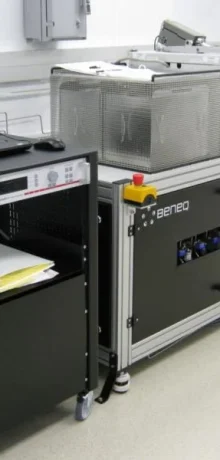

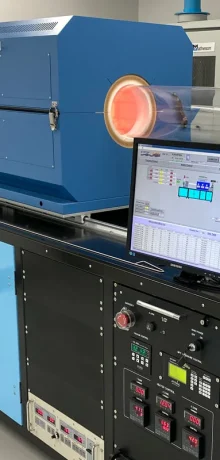
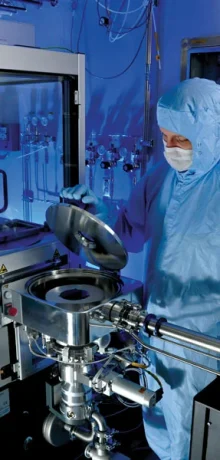
Finally, the RIC2D labs also have a dedicated chemicals storage room, where all the chemical materials are stored in bulk, and dispatched to users in needed quantities.
Consumables rooms, where general inventory and essential items are kept in stock.
Office spaces, where the specialist lab staff reside.

Ground Floor, Arzanah Building
Khalifa University, SAN Campus
Abu Dhabi, United Arab Emirates
Postal Address
Research & Innovation Center for Graphene and 2D Materials
Khalifa University
P.O. Box: 127788,
Abu Dhabi, UAE
Khalifa University
P.O. Box: 127788,
Abu Dhabi, UAE